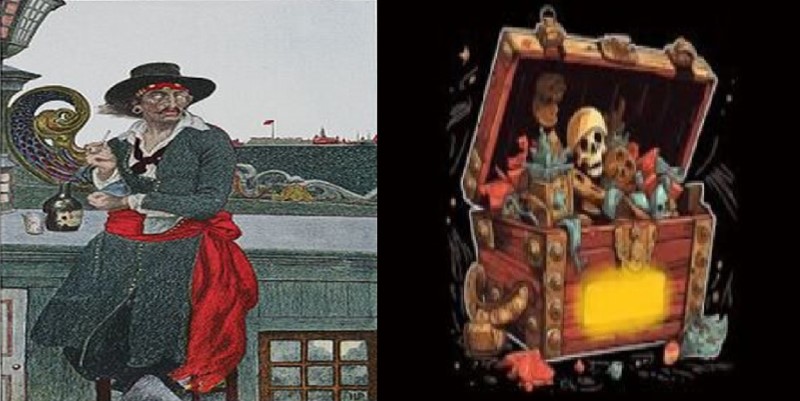
He was born in a coastal town in Scotland in 1645. Like all the other boys in the neighbourhood, he dreamed of becoming a sailor. This was an era of bloodthirsty pirates and the privateers who hunted them. William Kidd chose to hunt pirates. The most of the pirates were in the New World, so, he crossed the ocean when the time came. Years passed since and by his fifties, William Kidd had reached the pinnacle of his profession, building an impeccable reputation and becoming a captain. His dreams came true when he married a young, wealthy widow. Then he received a tempting offer from London.
There, he was introduced to Lord Bellomont, the governor of New York and Massachusetts, who was also a member of the British Parliament. Lord Bellomont had strong political and business connections on both sides of the Atlantic. Having heard of Kidd’s exploits as a privateer, Lord Bellomont during his time as governor of Barbados, offered him the opportunity to lead an expedition to eradicate piracy in the Indian Ocean and the Red Sea. Pirates such as Henry Avery and Thomas Tew had damaged the British Empire’s relationships with the Mughal and Arab empires. The Royal Household needed a professional pirate hunter to rectify the situation.

Captain Kidd was promised a license to capture French ships. He was also given a three-masted warship equipped with 30 guns and a crew of 100 experienced sailors. Several members of Parliament supported the expedition, including Lords Somers, Orford, Romney and Shrewsbury, as well as Lord Bellomont. The expedition was funded by the financier Edmund Harrison. No privateer had ever been offered such a thing before.
However, just as foam on the sea can hide treacherous reefs, politicians’ promises can conceal dangers. By granting the pirate hunter enormous powers, the lords promised Kidd full protection and patronage if he seized the opportunity to plunder a wealthy ship. In effect, he was being offered the chance to become an undercover pirate. The greedy politicians’ scheme was driven by their desire for profit. They demanded the lion’s share of the profits from the privateer’s legal and illegal activities. Kidd himself was left with crumbs, and his sailors with even less. Kidd was just a seaman and had no understanding of the cunning politicians’ behind-the-scenes manoeuvrings. Diplomacy is the art of disguising complex intentions with simple words. Most long-serving politicians have their own interpretation of honor — if they have any at all.
Kidd was at an age when men typically strive to reach the pinnacle of their careers, drawing on their accumulated knowledge and experience. Such a man is often vain and ambitious, taking offence when others underestimate him. Kidd may have realised the risks of the venture. However, the politicians made him a tempting offer, guaranteeing full support and protection. He may have seen this as an opportunity presented by fate. Driven by ambition, he plunged headlong into the venture.
In May 1696, as the ‘Adventurer’s Galley’ was preparing to leave Plymouth, the crew were informed of the terms of their contract. Many sailors went ashore as a result of the low pay for the dangerous work ahead. They could earn more in the Royal Navy. Kidd then sailed to New York in the hope of recruiting reliable men with whom he had worked for many years. He managed to recruit a crew there, bringing his total number of sailors to 160. After buying wine in Madeira, the ship set sail for the Cape of Good Hope. Nine months later, they rounded Africa and entered the Indian Ocean. There was a lull in Madagascar, but the neighbouring Comoros Islands were teeming with pirates, so Kidd went there instead. They pursued the pirates, but they hid in their usual haunts. This was a disappointing outcome, and the money spent on ship repairs and provisions quickly depleted. Kidd lost nearly a third of his crew to the African plague. Some simply deserted to join the pirates.
Kidd recruited his crew in Madagascar, but it soon became clear that the sailors he had hired were pirates themselves. They soon began to ‘muddy the waters’ and incite the crew to piracy. Kidd found himself in a difficult situation: he was surrounded by evil individuals and a mutiny was brewing on the ship. During one of the altercations, he lost his temper and hit a gunner who was among the mutineers with a heavy iron bucket. The gunner was dead, mutiny was quelled, but not for long.
Two years had passed since they left Plymouth. Letters from officials arrived threatening to replace Kidd and demanding results and gold. One day, with the pressure mounting from all sides, he made up his mind. After a night of contemplation, Kidd woke up a pirate the next morning. He announced to the crew, “We have been unsuccessful so far, but take courage, my lads! We will make our fortune soon!”
The crew welcomed his decision and they set sail for the Bab el Mandeb Strait. On the fourth day, in the evening, sailor shouted from the mast that he sees three ships on the horizon. They turned out to be a merchant ship accompanied by two warships. It was here that Kidd made a rash mistake that would cost him his reputation. As he approached the merchant ship, he fired his cannon and offered to surrender. However, the escort ships began to pursue him. Kidd escaped during the night and fled to the coast of India. However, his ship was recognised during the skirmish, and news of the pirate privateer soon reached the authorities.
It was January 1698. Kidd was sailing south along the Malabar Coast. Just off the southernmost tip of Cape Cormorant, he seized the wealthy ‘Qaeda Merchant’ ship. Its captain was English, and the ship belonged to the English East India Company. This was the same company whose employees had been almost torn to pieces by an angry Muslim mob following the rampage of the pirate Henry Avery. The captain of the captured ship accused Kidd of piracy, but he made no secret of his intentions and took the prize. The loot was sold on the coast, after which Kidd sailed for Madagascar in the captured ship. After dividing the £15,000 booty (the equivalent of 3 million dollars today), almost all of the sailors and pirates deserted Kidd. He sank the dilapidated ‘Adventure Galley’ and sailed to America on the captured ship, renaming it the ‘Adventure Prize’.
Kidd had no idea that by capturing the English East India Company ship, he had sealed his own fate. Not only had he broken the terms of his contract, he had done the exact opposite. His patron, Bellomont, and the other lords disowned this dangerous fool, thereby risking the loss of their own social standing.
Kidd’s subsequent actions were foolish. Unlike Henry Avery, he lacked the sense to disappear with looted gold and wait for better times hiding somewhere. He had naively hoped that Lord Bellomont would bail him out.
He didn’t have the courage to continue being a pirate. Instead, he hid some of his treasure on a small island off the coast of Long Island, before surrendering to Lord Bellomont in Boston. Bellomont ordered Kidd’s arrest and held him in jail until he revealed the treasure’s location. Kidd was then sent to London in chains to stand trial.
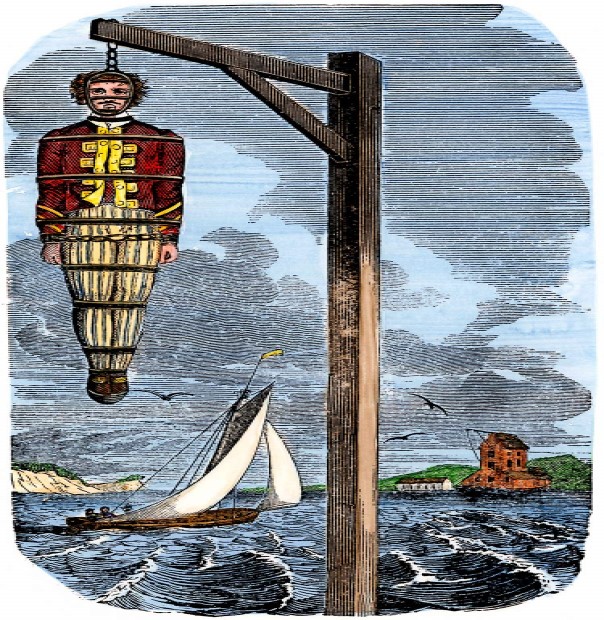
He was questioned in Parliament, but the records of his interrogation mysteriously disappeared. This was no coincidence; they contained compromising information about his associates. The Lords, who had once promised to support him, now wanted Kidd to be hanged as soon as possible before he could reveal any more information. Following a lengthy trial in May 1701, the privateer and pirate William Kidd was found guilty of piracy and the murder of his cannon master. He was unlucky on the gallows, too: the first rope broke under his weight, so he was hanged a second time. Kidd’s body was placed in an iron cage in the River Thames to deter others from following in the pirate’s footsteps. It remained there for 20 years, until the seawater had bleached the bones white.
AFTERWORDS.
Many years passed. Recently, treasure hunters discovered a 50 kg bar of silver in the waters off the north-eastern tip of Madagascar, near Santa Maria Island. This is where Kidd shared his loot with his crew and sank his frigate, the Adventure Galley. The ingot caused a furor among the public and was displayed at a special ceremony, at which officials announced that it was part of a hoard belonging to the famous 17th-century Scottish pirate William Kidd.
American treasure hunter Barry Clifford, who discovered the bar, had the following to say about his find: “It hit me over the head and I thought, ‘What the hell has happened to me? I didn’t expect this, but there’s more to it than that. I was at the bottom of the pit where I found the silver ingot, and that pit was filled with metal. It’s too dark to see what kind of metal it is, but my metal detector is crackling, telling me there’s metal all around”.
The treasure of Captain Kidd is legendary. People have been searching for it for three hundred years. Experts believe that the silver ingot marked with the letters ‘S’ and ‘T’ was cast in Bolivia in the 17-th century. They also think that the ship was built in England. However, more evidence is needed to link the ingot to Captain Kidd. Although the location of the ship, which is believed to have sunk in 1698, has been known for many years, the silver ingot was only recently discovered. Barry Clifford confirmed that his metal detector sounded an alarm while he was diving at the wreck site, but the water was too cloudy to see anything. Timothy Smart, the British Ambassador to Madagascar who attended the ceremony, said he hoped Mr Clifford’s latest discovery would improve Madagascar’s image as a tourist destination. The ingot is on display in a local museum.
All legends become myths. One such legend is that Captain Kidd hid most of his treasure elsewhere, sparking a global treasure-hunting boom. This legend inspired Robert Louis Stevenson to write his famous book Treasure Island. However, even he could not fathom why an honest captain and privateer would turn to piracy. The myths continue to grow.
When reflecting on what turns an ordinary person into a criminal, I have tried to understand the motivations behind it. However, psychologists have been studying and interpreting these motives for a long time. I have simply presented their findings in narrative form.
© Copyright: Walter Maria, 2018
Certificate of Publication No.218072801865
Be First to Comment