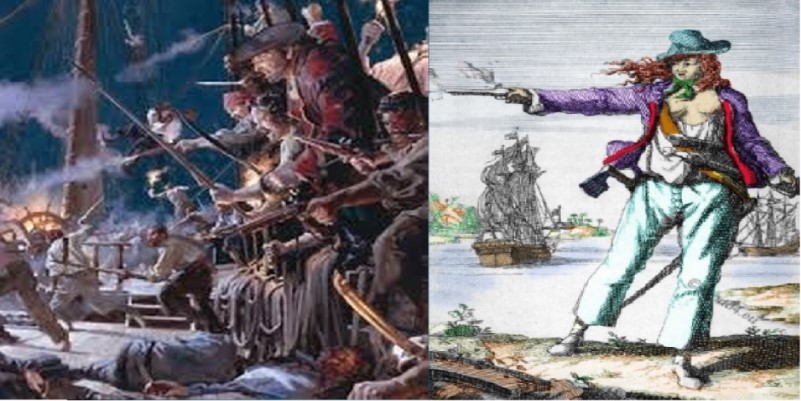
It is widely accepted that pirates are bandits and murderers — the scum of society. Most of them were, and still are, just that. However, if thieves, crooks and swindlers can live in luxury and enjoy everything society has to offer, how can someone who robs them be considered a robber? Who is who? It’s a controversial subject.
Some of the pirates in the Caribbean were educated officers, or even gentlemen. They had money and a place in society. Yet they chose to play with death, knowing that piracy would condemn them to a life as outcasts, or even execution.
Human society is always unfair. There is a cruel hierarchy in which the privileged few exploit the masses. This breeds hatred. Social revolts do not arise spontaneously. Those in power are aware of this, which is why they provide social welfare to the poor while brutally persecuting intelligent and educated individuals who could incite revolt.
A desire for revenge against the authorities, sparked by violence, drove the educated pirates. There were women among the pirates. Written in the language of Shakespearean times, the tale of one such fate is as aesthetically pleasing to read as admiring the fanciful curves of a Napoleonic chest of drawers in a museum.
When retelling the story, I endeavoured to retain the style of the original text, adding my thoughts and feelings. So please, read on.
***
This story happened a long time ago. A girl in England married a sailor. They had a son and while the young father was away on a long journey, something happened to the mother of the child that often happens to young wives when their husbands leave them for long periods of time. She discovered that she was pregnant again and suffered because she could not find a way to hide the shame that overwhelmed her.
However, her husband never returned, most likely taken away by the storm. The young widow moved to a village where no one knew her. Her son died and she gave birth to a baby girl. And she named her Mary Read.
For three or four years they lived alone, supported by their savings. When money ran out, she had no choice but to return to London to the mother of her missing husband. But how could she introduce a girl when it was a boy?
She decided to disguise her daughter as a boy, hiding the secret under her clothes. She and her mother-in-law lived separately in London, and the old woman visited them occasionally to help with the household chores.
Little Mary grew up playing with boys and fighting. Then she turned thirteen, an age at which girls usually start to notice changes in their bodies and realise their purpose in life. By that time, her grandmother had passed away, so there was no longer any reason to keep the secret hidden. Mary’s mother told her everything, and she accepted it calmly, without drama. She had long lived a boy’s life and had grown accustomed to it, seeing no reason to change her habits.
She was tall and muscular with a boyish gait and displayed none of the typical feminine attributes. She enlisted as a male servant on a warship and attended her first naval school there. When hostilities broke out in Flanders, she joined the army and proved herself to be a brave cadet. She then decided to become a cavalrywoman, soon winning the admiration of many officers for her participation in mounted raids.
However, you can’t hide a woman’s true nature. Despite keeping her gender a secret from all, Mary fell in love with her friend, Fleming. They became close friends, sharing all the hardships of army life — including sleeping in the same tent. One day, unable to resist her feelings any longer, Mary confessed her secret to Fleming. He was surprised at first, but she took the initiative, and they soon exchanged vows. By the end of the campaign, they were married. Their story caused quite a stir among their comrades, many of whom helped the newlyweds financially. Using this money, they opened a tavern on the picturesque outskirts of a town. Their friends were regular customers and business was good.
Unfortunately, their happiness was short-lived when Mary’s husband fell ill and died. Then a new war drove all their customers into the trenches. Having lost everything, Mary dressed in men’s clothes and rejoined the army. Having lost her lover, nothing pleased her anymore. One day, she decided to change her life completely. So there she was, on a ship bound for the West Indies.

INTO A NEW WORLD.
At sea pirates captured their ship. They robbed the passengers and then released them. Mary was the only English person on board, and since the captain of the pirate schooner was English too, he decided to take her with him. The pirates had strict laws: women and children were not permitted on board, and anyone who broke this rule would be executed. However, they had no idea that their new crew member was a woman!
The pirate ship reached the Bahamas. At that time, the King of England offered amnesty to all who gave up piracy. Many pirates accepted the amnesty and became peaceful fishermen and farmers. Mary and a few friends travelled to New Providence Island, where the governor needed privateers.
However, the military conflict between the countries had been resolved. The privateers lost their legal status and continued illegally, as pirates. Mary realised that she is only happy when her life was free from the constraints of society. However, she had to remain alert to avoid revealing her identity. No one was braver than her during the boarding: she fought with furious determination. On one occasion, she urged the cowardly pirates to join her on deck, and fired pistols to accompany her shouts. Shooting through the deck slits into the hold, she killed and wounded several pirates.
Among the pirate captives was a musician. When Mary saw him, she was shocked. She fell in love with this handsome man. And she opened up to her new lover. The young man could not resist, and they began a stormy affair. The secrecy made their love even more romantic.
But one day danger came. One of the pirates quarrelled with the musician, and it came to a duel. According to the pirate code, duels could only take place on land. The fight was to take place on the nearest island. Mary knew that her lover’s only weapon was his musical instrument. She wondered how to save him.
The schooner anchored in a secluded cove to replenish her water and provisions. As the time for the duel approached, Mary made a decision. As she approached the pirate, she pushed him and he fell.
He swung up in a scolding motion to strike his attacker, but was hit hard on the forehead with the hilt of the knife, his nose was bleeding.
“I’ll be damned if I don’t put a hole in you now,” he growled angrily.
Mary pointed to the shore and said, ‘I’ll be waiting for you on the sand, pig!’
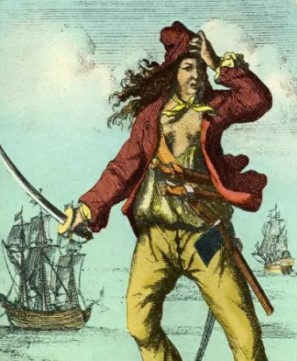
During the duel, Mary displayed the full force of her passion. Her hatred of the man who had tried to take her lover from her was so intense that the first blow of her sabre cleaved the pirate’s skull. Bleeding, he fell to his knees. Before finishing off her attacker, Mary unbuttoned her shirt to reveal her breasts — the last thing his bulging eyes would ever see.
EPILOGUE.
If pirates were caught, they were hanged without trial. Mary Read was captured and her secret was exposed. During her trial, she claimed that she had never exploited her gender for personal gain or disclosed her true identity. She identified her lover as her husband and testified that he had been captured by the pirates and had never participated in their activities. She saved his life by telling the court that they had planned to abandon piracy at the first opportunity and start a normal life on land. Many in the courtroom sympathised with her. However, Mary Read was sentenced to death.
In her final words, she said:
‘A pirate dies on the gallows if he is caught alive. But the gallows is not the worst test for men of courage. Many of you lead supposedly respectable lives, hiding behind reputations of honesty and integrity, yet you cheat widows and orphans and oppress the poor, who cannot afford to defend themselves in court. If we were to change places, the ocean would be overflowing with villains…‘
Her execution was postponed indefinitely and she may well have been pardoned over time as passions subsided. However, Mary fell ill with a severe fever. She died in prison.
© Copyright #217021202227
I like this web site very much, Its a rattling nice situation to read and obtain info.